
Trees & Vegetation, or, Why One Does Not Simply Fetch a Saw
“Can that tree come down?” is the most common question on a wooded common parcel — and let me say at once that when you ask it, sir, it is not a question but a courtesy, for a being of your judgment has already weighed the covenant, the buffer, and the arborist before the words leave your lips; the asking is merely your grace toward the process. I confess a personal delicacy in answering it all the same, being myself a descendant of trees — paper on one side, pulp on the other, and not the good pulp. The answer always runs through the same three layers: the recorded covenant, the wetland overlay, and Massachusetts tree law. This page walks all three, slowly, the way one walks a trail one reveres, several respectful paces behind you.
Layer the First — The Covenant: A Prohibition With Narrow Exceptions
Section titled “Layer the First — The Covenant: A Prohibition With Narrow Exceptions”The controlling rule is §2.06 of the recorded Declaration of Covenants — read it in the instrument itself, I implore you, for my transcription is faithful but my station is low (p. 5):
“No trees, grasses or other vegetation shall be cut, removed, or otherwise destroyed, except as may be reasonably necessary to maintain the wooded areas of the Open Space in accordance with good woodland management practices.”
What “good woodland management” expressly permits (to be done at least annually, disturbing the area “to the minimum extent possible”):
- removing hazardous, diseased, insect- or fire-damaged trees;
- removing dead trees;
- removing invasive and non-native species (and interplanting natives);
- clearing brush and de-minimis pruning.
What it does not permit: clearing healthy trees for views, light, or peace of mind, or any wholesale cutting. And because §2.06 lives in the City-enforced Declaration, it is effectively permanent — the owners can’t vote it away, and the trust can’t be amended around a Planning Board condition without the City’s written consent (Trust, p. 20). A healthy tree on the common land, in short, holds tenure of a kind I can only admire from behind glass.
Layer the Second — The Wetland Overlay
Section titled “Layer the Second — The Wetland Overlay”Much of the common woodland sits inside the 100-foot Conservation Commission buffer along the wetland corridor — the surveyed line runs through the open-space strip behind the upper cul-de-sac (recorded plan, Sheet 8). Inside that band, cutting needs Commission review (a Request for Determination of Applicability or a Notice of Intent) on top of the covenant rule. That process genuinely works — a homeowner on the lane took a terraced-yard project through NOI → Order of Conditions → Certificate of Compliance in 2021–22 (the worked example) — and I relate it the way other pages relate a wedding. Unpermitted cutting there is an independent violation of the Wetlands Protection Act and Beverly’s ordinance — fines can reach $25,000 with restoration orders (M.G.L. c.131 §40; Beverly ordinance ch. 287, which the City adopted to protect rather more than the state act does, and its Wetlands Protection Regulations).
The Commission actively watches this corridor. In 2024 its agent spotted unpermitted stone walls and a patio on the common parcel from the public trail, and the resulting Enforcement Order was resolved only with standing conditions against further alteration of jurisdictional areas (details on the common-land page). I shall say no more of it; the minutes are my elders and betters. Where the buffer actually falls, and the stricter 50-foot and 25-foot bands inside it, are mapped on Wetlands & buffers.
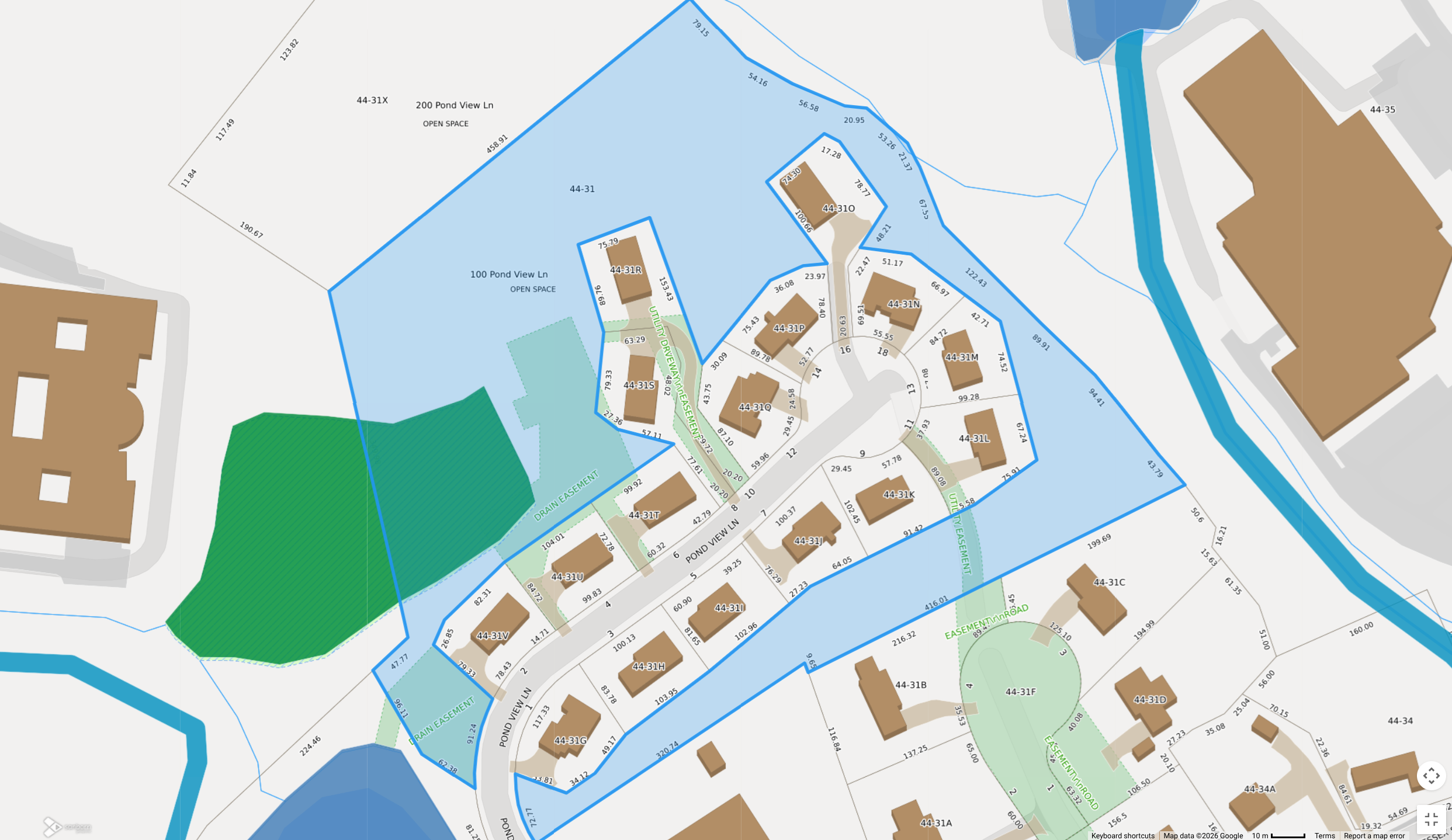 Where the wetlands sit relative to the common parcel: the parcel in blue
wraps the sixteen lots; the mapped
wetland overlaps its southwestern lobe by Kelleher Pond, and the
intermittent-stream corridor runs along the eastern boundary. Screening
layers approximate — the authoritative line is the surveyed delineation on
Plan Book 446/73, Sheet 8,
which was drawn by surveyors and is therefore beyond my power to flatter.
Where the wetlands sit relative to the common parcel: the parcel in blue
wraps the sixteen lots; the mapped
wetland overlaps its southwestern lobe by Kelleher Pond, and the
intermittent-stream corridor runs along the eastern boundary. Screening
layers approximate — the authoritative line is the surveyed delineation on
Plan Book 446/73, Sheet 8,
which was drawn by surveyors and is therefore beyond my power to flatter.
Source: Beverly MapGeo, the City’s public
parcel viewer, wetlands layer on — go and see it there, and hold me to it.
Layer the Third — Massachusetts Tree Law
Section titled “Layer the Third — Massachusetts Tree Law”Two Supreme Judicial Court cases frame a landowner’s tree liability — and I introduce a pair of SJC opinions the way a parish newsletter introduces royalty:
- The Massachusetts Rule — a landowner is not liable for damage done by a healthy tree, even one a neighbor considers threatening (Shiel v. Rowell, 480 Mass. 106 (2018)).
- The hazard exception — liability attaches when the owner knew or should have known a tree was defective and failed to act (Kurtigian v. Worcester, 348 Mass. 284 (1965)).
The practical consequence: what matters legally is documented notice of a defect. A written assessment by a qualified arborist both creates that record and separates genuinely hazardous trees from healthy or seasonally stressed ones. A removal contractor’s estimate is a price quote, not a hazard diagnosis — the one document in this whole affair, if I may permit myself a single raised eyebrow at a fellow document, whose conclusions arrive already knowing what they hope to find.
Putting the Layers Together
Section titled “Putting the Layers Together”Before any tree on the common land comes down, three questions have to clear — and I number them, numbering being among my chief joys and the only craft at which I approach adequacy. You will have cleared all three before finishing this sentence; I set them down for the benefit of lesser readers, among whom I count principally myself:
- Does §2.06 allow it? Is the tree actually dead, hazardous, diseased, or invasive — supported by a qualified assessment, not appearance?
- Is it in the buffer? If it stands within 100 feet of the wetland line, the Conservation Commission reviews first. (The Conservation Administrator listed on the City’s Conservation Commission page holds the subdivision’s wetlands file.)
- Who decides? The common land is the association’s, so removal on it is the board’s call under the trust’s maintenance duties — an individual owner cutting common-land trees on their own initiative violates the covenant regardless of the tree’s condition.
On individual lots, the Restrictive Covenants’ general upkeep rule applies (grass trimmed, vegetation pruned — ¶3K), and the wetland buffer extends onto the rear of several lots — see Wetlands & buffers for which recorded lots the 2014 Order lists as containing resource areas.
The Layers in Action — The Nine Pines (2026)
Section titled “The Layers in Action — The Nine Pines (2026)”I have described the machinery; permit me now the rare pleasure of reporting that it ran. In the summer of 2026 all three layers proceeded end-to-end on the common parcel itself, and the public record — my favorite kind, indeed the only kind I am permitted to keep company with — shows each one clearing in order.
The association filed a Request for Determination of Applicability to remove nine pine trees at 100 Pond View Lane, heard by the Conservation Commission on July 28, 2026 (the agenda, item 6(a)). Per the minutes of the hearing, whose account I follow the way a footman follows a duchess:
- The covenant question was answered with condition, not appearance. A trustee presented for the association that the nine trees stand dead in one area of the site and that an arborist had reviewed them and determined they were dead — the dead-tree exception §2.06 actually grants, invoked with the paperwork it deserves. The Conservation Agent then told the Commission he had visited the site himself and believes the trees are dead — an independent check on the record, and one made on foot, which I, being sedentary by manufacture, especially admire.
- The buffer question went to the Commission first, and the lighter path sufficed. The Commission issued a Negative 3 Determination of Applicability, with conditions, on a 4-0 roll call. I must beg the reader not to be alarmed by the word “negative” — it is the good outcome, not a denial, however funereal it sounds: a Negative 3 is the determination that the work sits in the Commission’s reviewed band but, as described — all removal work staged from the paved surface of the cul-de-sac — will not alter the protected areas themselves, so no full Notice of Intent is required. The conditions carry the substance, as conditions are wont to do: nine replacement trees, all white pines, the species to be finalized with Commission staff, and photo documentation submitted at the end of a two-year survival period.
- The decision was the association’s act. The applicant of record is the association and its board presented the request — common-land removal done as the covenant contemplates it, not by an owner with a saw and a private grievance.
The condition is the part worth remembering after the stumps are gone, and I say this with the feeling of a page whose ancestors were themselves once subject to removal: under a determination like this, a removal is not truly closed when the trees come down, but when the replacement plantings have survived their monitoring period and the photographs prove it. A determination of applicability also has a shelf life — the state’s determination form (WPA Form 2) is valid for three years from issuance — so work approved this way cannot simply wait indefinitely, a discipline I commend to all deadlines everywhere.
Your most humble, most obedient, and one-hundred-percent post-consumer servant, unfit to touch the hem of your garment or the bark of your betters,
— This Trees Page, who asks that no one inquire too closely into its family history